

When you buy a new build home, a great deal of the protection you rely on sits quietly in the background. Most buyers know their property comes with a structural warranty, and many will recognise the name LABC Warranty as one of the providers that sits behind UK new build developments.
Far fewer have ever seen, let alone read, the document that defines what “built properly” actually means in practice. That document is the LABC Warranty Technical Manual, and it is one of the most important reference points in the entire new build process.
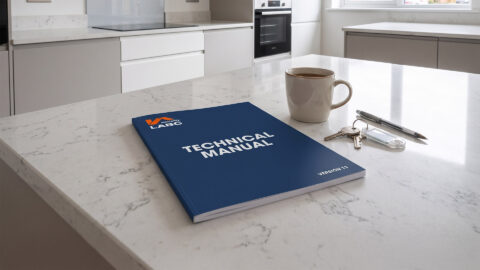
At New Build Inspections, we work with this kind of technical standard every day. Our inspectors come from backgrounds in site management, surveying, architecture and the wider construction industry, and a large part of our job is understanding the gap between how a home should be built and how it has actually been built. The Technical Manual is the benchmark that sits at the centre of that comparison for any home covered by an LABC Warranty policy. This article explains what the manual is, how it is structured, what changed in the latest version, and crucially, what it all means for you as the person who will live in the finished home.
What the LABC Warranty Technical Manual Actually Is
LABC Warranty is one of the UK’s larger providers of structural warranties for new homes and buildings. Its policies are widely accepted by mortgage lenders, which is a significant part of why developers use them, because a recognised warranty is usually a precondition of buyers being able to obtain a mortgage at all. The company works in partnership with Local Authority Building Control, so a development covered by an LABC Warranty policy is reviewed both for building regulations compliance and for the warranty provider’s own risk management standards.
The Technical Manual is the rulebook for that second strand. It sets out the technical requirements a building must meet in order to qualify for, and retain, LABC Warranty cover. It is written primarily for developers, builders and designers, and it tells them precisely what is expected at every stage of construction, from the ground investigation before a single spade goes in, right through to the finishes inside the completed home.
It is worth being clear about what the manual is and is not. It is not the warranty policy itself, and it is not a statement of your rights as a homeowner. The policy document is a separate insurance contract. Neither is the Technical Manual a substitute for Building Regulations. In fact LABC Warranty is explicit that the manual is not intended to demonstrate compliance with Building Regulations or other statutory requirements, and that its illustrations are indicative of warranty expectations rather than working construction drawings. What the manual does is define the standard of design, materials and workmanship that LABC Warranty requires before it is willing to stand behind a home, and in several areas that standard is deliberately set higher than the minimum the law would accept.
That last point matters more than it might first appear. The manual states that LABC Warranty will generally accept work that satisfies the relevant Building Regulations, except where the warranty itself requires a higher standard, with durability and minimum service life given as examples. In other words, a home can in principle meet the legal minimum and still fall short of what the warranty expects. Understanding where those higher bars sit is exactly the kind of knowledge that separates a thorough independent inspection from a quick once over.
Why a Document Like This Exists at All
New homes are complex things to build. A single dwelling involves dozens of trades, materials and systems, each with its own failure points, and each handed over from one team to the next as the build progresses. Foundations, drainage, walls, roofs, windows, heating, ventilation and electrics all have to come together correctly, and a weakness in any one of them can cause problems that only emerge months or years after completion.
A technical manual of this kind exists to reduce that risk before it becomes a claim. By setting out clear requirements for each element, the warranty provider is trying to ensure that homes are built in a way that will not generate expensive structural failures during the cover period. That is in the insurer’s interest, of course, but it is also very much in yours, because the same requirements are what stand between you and the kind of serious defects that are difficult and disruptive to put right once you have moved in.
This is also why the warranty period is structured the way it is. An LABC new homes policy typically runs for ten years, and that decade is usually split into two distinct phases. The first two years are the defects insurance period, during which the builder remains responsible for putting right issues that breach the warranty’s standards. The remaining years, generally years three to ten, form the structural insurance period, which covers major structural defects in elements such as foundations, load bearing walls, roofs and chimneys. The Technical Manual underpins the whole of that timeline, because it defines what counts as having been built correctly in the first place.
How the Manual Is Organised
The current Technical Manual is built around a clear three part logic that runs through the entire document, and once you understand that logic the rest of it becomes far easier to navigate.
At the top sit the Functional Requirements. These are the core standards that must be met in all cases, and they are set out at the front of the manual rather than buried in any one section. There are five of them, and together they form the foundation on which everything else rests. The first concerns Building Regulations, establishing that completed works must comply with the relevant regulations wherever a performance requirement applies. The second covers structural design, requiring that all buildings are structurally sound and that structural design is carried out by suitably qualified people in accordance with the relevant British Standards and Eurocodes. The third deals with workmanship, requiring that work is carried out by technically competent people in a workmanlike manner and within the manual’s stated tolerances. The fourth addresses materials, products and building systems, requiring that they are suitable for their intended purpose. The fifth concerns design and specifications, requiring that designs prove satisfactory performance and contain enough detail to allow accurate construction and inspection.
Beneath the Functional Requirements sit the Performance Requirements. Each section of the manual contains these, and they are presented in a distinctive way, set in bold text against a shaded background so they stand out from the surrounding guidance. The relationship between the two layers is important: meeting the Performance Requirements is how a builder demonstrates that the broader Functional Requirements have been satisfied. The reintroduction of clearly identified Performance Requirements is one of the headline features of the latest version, and it was done specifically to give greater clarity about what the warranty expects.
The third layer is the Supporting Guidance. Every Performance Requirement is accompanied by guidance that offers acceptable solutions and best practice detailing for meeting it. This is where the bulk of the manual’s detail lives, and it is the part that explains how, in practical terms, a requirement can be satisfied. Importantly, the guidance is not the only permitted route. Alternative solutions may be acceptable, provided they are agreed in advance of construction rather than presented after the fact. That flexibility is sensible, but it also places a clear emphasis on getting agreement up front, which is a recurring theme throughout the document.
There is one further point on scope that homeowners should understand. The supporting guidance is aimed primarily at low rise construction, defined as buildings of five storeys or fewer including the ground floor. Larger and more complex projects are handled through LABC Warranty’s Major Projects service, with project specific requirements confirmed separately. For the vast majority of houses and smaller apartment blocks, though, the standard manual is the document that applies.
A Tour Through the Twenty Two Sections
The heart of the manual is a sequence of twenty two sections, each addressing a specific build element, arranged to follow a traditional build sequence from the ground upwards. Three appendices then deal with more general matters. Walking through the sections in order is the clearest way to appreciate just how comprehensive the document is, and how many opportunities there are along the way for things to go wrong if corners are cut.
It begins below ground. Section one covers ground conditions, including site investigation and the management of ground contaminants, setting out how a site should be assessed for hazards before building starts. Section two deals with waterproofing below ground storeys and structures, a section that in this version was renamed from the older “Basements” heading to better reflect what it covers. Section three addresses foundations in considerable depth, spanning mass fill and strip foundations, piles, rafts, engineered fill, vibratory ground improvement, the effect of trees and clay soils, and retaining walls.
From there the manual works upwards through the structure. Section four covers ground floors, including suspended floors, ground supported slabs and matters such as screeds and underfloor heating. Section five handles drainage, both above and below ground. Section six, on external walls, is one of the largest in the manual, with separate guidance for masonry, timber frame, light gauge steel frame, render, claddings, parapets and gable spandrel panels. Section seven covers internal walls across masonry, timber stud, metal stud and spandrel panels, together with fire resistance, cavity barriers and fire stopping.
The middle sections deal with the building’s openings and vertical circulation. Section eight covers external windows and doors, with additional requirements depending on whether frames are uPVC, timber, aluminium or steel, and further guidance for stacked window assemblies and bi-fold doors. Section nine covers stairs of all types. Section ten covers upper floors in both timber and concrete, again including fire resistance and fire stopping. Section eleven, on roofs, is another extensive section, ranging across pitched roof structures, roof cassettes, tile and slate coverings, flat roofs, green roofs, metal deck roofing, blue roofs and podium decks.
The remaining sections address the elements that complete and service the home. Section twelve covers roof terraces and balconies. Section thirteen covers chimneys and flues. Section fourteen covers driveways and paving. Section fifteen covers heating systems, including low and zero carbon technologies. Section sixteen covers ventilation and extraction. Section seventeen covers electrical services, including mains supply and photovoltaic solar panels. Section eighteen covers cold water supply. Section nineteen covers non-habitable garages. Section twenty sets out tolerances, the permitted limits within which workmanship is judged acceptable.
The final two sections reflect the changing nature of how homes are built. Section twenty one covers modern methods of construction, addressing volumetric systems, closed panel timber and light gauge steel frame systems, structural insulated panels and insulated concrete formwork, along with the process by which such systems gain acceptance. Section twenty two covers conversions and retained elements, which in this version was expanded from an appendix into a full section, recognising how much building work now involves adapting existing structures rather than starting from scratch. The three appendices then cover finishes, the additional risks of coastal locations, and the requirements for materials, products and building systems.
What Changed in Version 13
The manual is periodically revised, and the current edition, version 13, applies to homes quoted on or after the first of January 2026. This was described by LABC Warranty as a comprehensive review with significant updates, and several of the changes are worth highlighting because they reflect where the industry’s risks are currently concentrated.
The most visible change is a new portrait layout and a general simplification of the Functional Requirements, alongside the reintroduction of clearly marked Performance Requirements discussed earlier. Two entirely new sections were also introduced. The first is the modern methods of construction section, reflecting the growth of factory built and panelised systems and the need for clear acceptance criteria around them. The second is the expanded conversions and retained elements section, acknowledging the volume of work that now involves keeping and adapting parts of existing buildings.
Beyond the structural reorganisation, many individual sections were rewritten or extended. The ground conditions guidance gained new material on managing ground contaminants, including site investigation, remediation strategy reporting and the specification and installation of gas resistant membranes. The waterproofing section gained new guidance on how below ground waterproofing meets above ground structures, and on dealing with penetrations through waterproofing, both of which are common failure points if not detailed correctly. The foundations guidance on piles was rewritten, with new material on hydraulically treated soils and on reinforced earth retaining walls.
The external walls section saw its masonry guidance broadened to cover masonry cladding to timber and light gauge steel frame structures, with new detail on cast stone masonry and on lintels. The render guidance was completely rewritten, and the parapets guidance now calls for at least three lines of defence given how exposed parapets are. The roofs section gained guidance on dormer construction, wall plates, bracing, plant and water tanks within cold roof voids, and revised ventilation provisions, along with reworked requirements for flat roof waterproofing systems and their protection after completion. Even at the level of detail, the direction of travel is consistent: more guidance, in more areas, aimed squarely at the points where defects most often arise.
For a homeowner, the practical takeaway from all of this is straightforward. The standard against which your home is judged is not static. If your home was quoted from the start of 2026 onwards, it falls under this newer and in several respects more demanding version, and an inspection informed by the current standard is more valuable than one working from outdated assumptions.
Durability and the Sixty Year Standard
One requirement in the manual deserves singling out, because it surprises many people and because it sits at the heart of why a structural warranty exists at all. Under the materials requirement, all load bearing structural elements that provide support to the home must have a service life of not less than sixty years, unless something different has been specifically agreed with LABC Warranty in advance.
Sixty years is a great deal longer than the warranty’s ten year cover period, and that is the point. The warranty does not expect the structure to last only as long as the policy. It expects the parts of the home that hold it up to be specified and built to endure for decades, with the warranty acting as financial protection during the early years when latent defects are most likely to reveal themselves. Other parts of the home, the manual acknowledges, have a shorter expected life and will need planned maintenance, repair or replacement over time, which is a normal and reasonable expectation for any building.
This distinction is genuinely useful to keep in mind as a homeowner. It draws a clear line between the elements that should simply not fail within a normal lifetime, such as foundations and load bearing walls, and the elements that are expected to wear and require upkeep, such as decorative finishes and certain fittings. When a defect appears, understanding which side of that line it falls on is often the first step in working out who is responsible for putting it right.
How This Connects to a Snagging Inspection
It would be easy to assume that, with a document this detailed standing behind every LABC covered home, an independent inspection is unnecessary. In practice the opposite is true, and the reasons are worth setting out plainly.
The Technical Manual describes how a home should be built and what the warranty provider’s surveyors review at key stages. It does not, and cannot, guarantee that every requirement has been met in every home. Construction is carried out by many different people under real world pressures of time and cost, and warranty risk management inspections are sampled at particular stages rather than being a line by line audit of the finished property. That is precisely the gap that a thorough, independent snagging inspection is designed to fill. An inspector working on your behalf examines the completed home in detail, identifies where the finished result falls short of the standard expected, and gives you a clear, documented basis for asking the developer to put things right.
The value of independence here is considerable. We work only for home buyers, never for developers or builders, which means our assessment carries no conflict of interest. When we identify an issue, we can raise it and pursue it on your behalf without any concern for an ongoing commercial relationship with the people who built your home. Familiarity with standards such as the LABC Warranty Technical Manual is part of what allows us to frame issues accurately, because the strongest snagging report is one that ties each defect to a recognised expectation rather than to mere personal preference.
There is also a timing dimension that connects directly to the warranty structure. The defects insurance period covers the first two years, and the manual underpins what counts as a defect during that window. The most effective time to have your home inspected is as close to completion as possible, and ideally before you legally complete where your builder permits access, so that issues can be identified and addressed while responsibility for them is clearest and while the developer still has the strongest incentive to act. Leaving problems undocumented makes them harder to attribute later and can complicate the process of having them resolved.
What This Means for You as a Homeowner
The LABC Warranty Technical Manual is, in the end, a reassuring document to know about. It demonstrates that there is a detailed, considered and regularly updated standard sitting behind your new home, covering every element from the ground beneath the foundations to the finishes on the walls, and in several areas demanding more than the legal minimum. The existence of that standard is part of why a recognised warranty gives lenders and buyers confidence in a property.
What the manual cannot do is inspect your specific home for you. A standard tells you what should have happened; only an inspection tells you what actually did. The two work best together. The warranty defines the benchmark, and an independent inspection checks your home against it and gives you the evidence to insist on the quality you have paid for.
If your new build home is covered by an LABC Warranty policy, understanding that the Technical Manual exists, and that it sets a clear and demanding standard, puts you in a stronger position from the outset. Pairing that knowledge with a thorough, independent snagging inspection is the most reliable way to make sure your home truly meets the standard it is supposed to. If you would like to talk through how an inspection works, or what to expect from your particular warranty, our team is always happy to help.
This article is intended as general guidance. The LABC Warranty Technical Manual and the warranty policy itself are the definitive sources on what your specific cover requires, and warranty terms can vary between policies and editions of the manual. For questions about your individual policy, refer to your own warranty documentation or speak to your provider.
